I help enterprise IT teams turn complex transformation work into clear processes, tools, and decisions.
I work where business needs, delivery processes, governance, and practical tooling meet.
Belgium & Luxembourg — Available from 1 June 2026
■ What I do
Four kinds of work, applied together across a transformation.
My role is to make complexity easier to understand, easier to discuss, and easier to run. I help teams clarify what is happening, structure the way forward, create artefacts people can actually use, and support the work with practical tools when needed. The differentiator is the combination; I provide the following expertise end-to-end in a single engagement.
Clarify complex situations
For teams dealing with scattered information, unclear ownership, messy processes, or too many moving parts.
- —Process, data and stakeholder analysis
- —Current-state mapping
- —Pain point synthesis
- —Root-cause clarification
Structure ways of working
For teams that need a clearer process, governance model, delivery approach, or operating rhythm.
- —Delivery and governance frameworks
- —Roles, responsibilities, and handovers
- —Decision points and approval flows
- —Templates, guides, and routines
Make work visible & usable
For teams that need artefacts people can understand, align on, and use without needing another meeting to explain them.
- —Visual models and diagrams
- —Figma prototypes and wireframes
- —Workshop and alignment material
- —Executive-ready synthesis views
Support with practical tools
For teams that need the process to become easier to run, track, improve, or explain to others.
- —SharePoint structures and lists
- —Power Automate workflows
- —Power BI dashboards
- —Jira / Confluence workspaces
- —Excel-based analysis and tracking
■ How I work
I am most useful when there is ambiguity, complexity, or too much information spread across too many places.
I start from intent, not templates.
Before producing an artefact, I clarify what the work needs to support: a decision, a behaviour, an approval, a handover, a discussion, or a practical next step.
I make reality visible.
I map how things actually work, including informal workarounds, unclear ownership, duplicated effort, hidden dependencies, and friction points.
I structure without overcomplicating.
I like clear structure, but not bureaucracy for its own sake. The goal is to help people move forward, not to create another layer of process nobody wants to use.
I design artefacts people can use.
I care about wording, layout, hierarchy, and usability. A deliverable only matters if people understand it, trust it, and actually use it.
I stay close to execution.
I do not stop at recommendations when the work needs something more practical. I can help translate the process into trackers, workflows, dashboards, prototypes, or working documentation.
Tools I often use Figma
Figma Visio
Visio Excel
Excel SharePoint
 Power Automate
 Power BI
 Jira
Jira Confluence
FigmaVisioExcelSharePointPower AutomatePower BIJiraConfluence■ Selected Work
Selected work from my experience inside the European HQs of one of the world's largest automotive manufacturers.
Details are intentionally kept high-level for confidentiality.
IT Landscape Modernization
Expand ↓Enterprise Application Redesign
Expand ↓■ Contact
If your team is dealing with unclear processes, scattered information, governance friction, or transformation work that needs to become more usable, I would be happy to talk.
Let's keep it simple: send me a message, and we can see if there is a fit.
Based in Belgium · Available for Consulting, Business Analysis, Process Design, and Transformation support roles
■ About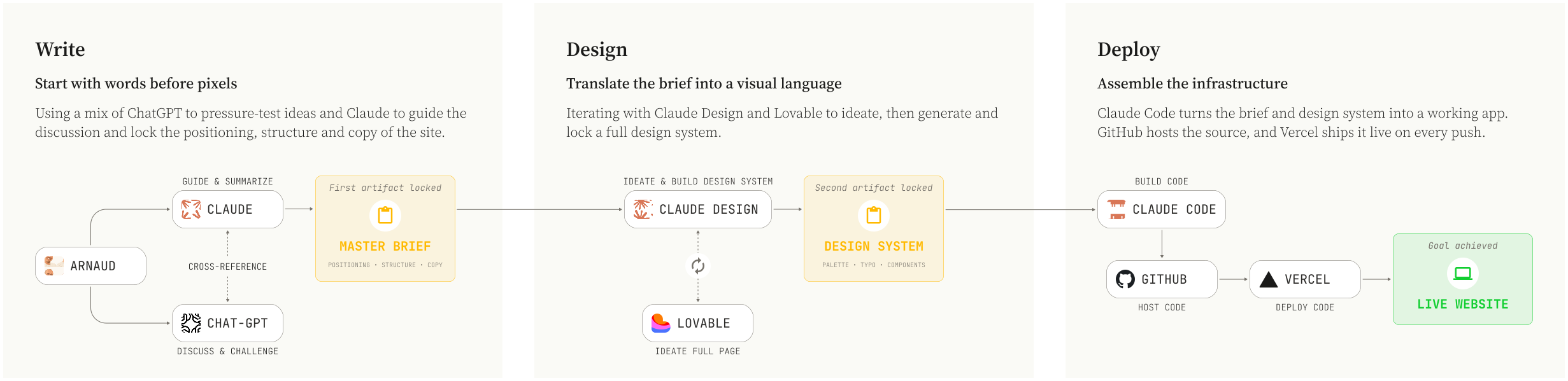
I am a Business Analyst working in Enterprise IT and Digital Transformation environments, with a strong focus on process clarity, governance, visual thinking, and practical tooling.
I enjoy the space between structure and execution: understanding how work really happens, making it visible, and turning it into something teams can use.
My background combines Business Analysis, Process Design, PMO and Governance work, UX/UI Thinking, and hands-on experience with the Microsoft 365 ecosystem.
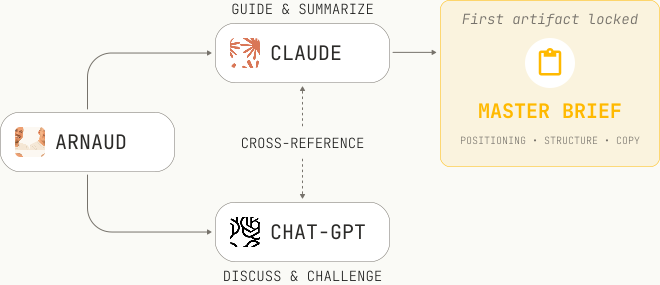
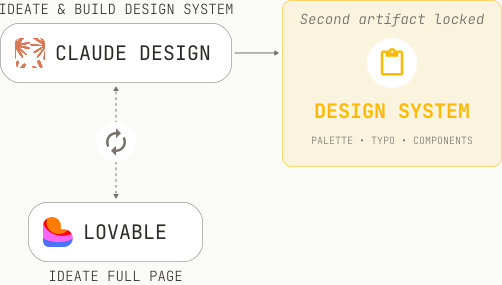
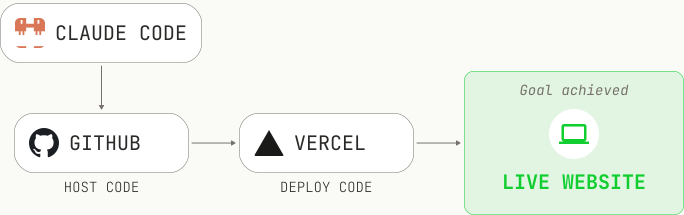
Outside of client work, I experiment with ways to combine strategy, design, automation, and AI-assisted prototyping to build clearer, faster, and more useful digital artefacts. Here is how I built this website:
Write
Start with words before pixels
Using a mix of ChatGPT to pressure-test ideas and Claude to guide the discussion and lock the positioning, structure and copy of the site.
Design
Translate the brief into a visual language
Iterating with Claude Design and Lovable to ideate, then generate and lock a full design system.
Deploy
Assemble the infrastructure
Claude Code turns the brief and design system into a working app. GitHub hosts the source, and Vercel ships it live on every push.